Tunisia - 25 September 2010 (2)


Our next stop was the very picturesque town of Sidi Bou Said, with white and blue buildings.  Not surprisingly, there were a lot of tourists and souvenir shops to tempt them. 

Kim & Barry in Restaurant in Sidi Bou Said
We walked up a very steep hill, making our way through the crowds, and went for lunch in a restaurant near the top.  We sat in the courtyard and were introduced to the “brik”.  This typical Tunisian starter comprises crispy fried pancakes filled with egg and whatever else you like.  I chose a cheese brik and chips.  I think I would have preferred it if the pancakes had not been fried as they were too greasy and I am a big fan of English-style pancakes.  Still it was a rare vegetarian option and we made a note.  We were all given a mint tea, but it came already made with far too much sugar for me.

After lunch, Caroline, Vic and Heuly decided to stay and explore Sidi Bou Said, but I was tired and went back with the others.  After all that walking and only a few hours sleep, I did my usual trick of falling asleep on the train going back.  Luckily, our stop was the end of the line and Anne and Robin were there to wake me up.  Anne and Robin would have had a good excuse for falling asleep too, because their room was at the back of the hotel – right next to the tram line, which kept them awake until late and then woke them up very early.

As we walked back down the Avenue Habib Bourguiba, we met Werner, the final member of our group.  He also came from Australia and was still recovering from the flight, so had not felt fit enough to join us on our long walk

After an afternoon of chores and a nap, we met up at 18.00 for the “admin meeting”.  We were asked to put $60 into the tip fund and Sue volunteered to look after the money.  I only had sterling and euros but contributed the equivalent – I hope.

Once we were all fully briefed and sorted, we went to a nearby restaurant for dinner.  I had vegetables and couscous, the only veggie option on most menus, and forced myself to drink a litre of water to avoid dehydration.  Werner told us about his experiences living in the former East Germany, especially after the war, and came near to tears at a couple of points.  I thought that he was a sweet old man.  Even though he had lived in Adelaide for many years, his German accent was still very strong.

Tunisia - 25 September 2010 (1)

Carthage
Horloge Obelisque
We had a basic breakfast of croissant and hot chocolate and met Kim and Sue, who were from Australia and had already been travelling for several weeks in Egypt and Uganda to make the most of their long flight.

Sanctuary of Tophet - Stelae
We set off at 08.00 and walked along the Avenue Habib Bourguiba under a blue sky, but avoiding the puddles from the rain the previous day.  We passed the “horloge obelisque”, which I had admired on the bus ride from the airport, when it had been illuminated.  Eventually we reached the TGM station and headed for the first site of ancient Carthage.


Sanctuary of Tophet - detail on a Stela
While we waited for Salah, our local guide, we went into a café where I tried a citronade.  The lemon was very refreshing and this became my drink of choice on the tour.  It was normally not that expensive a drink.  This one cost just D0.500. 


Sanctuary of Tophet
Salah appeared to be quite a character.  He arrived in the growing heat wearing a brown suit and white shoes.  His hair was either very greasy or had been seriously subjected to some Tunisian version of bryl-cream.  But, like all our guides on the tour, he was very interesting and seemed to know his stuff.  History is written by the victors and the Romans, who finally conquered and laid waste to Carthage after some close calls in the three Punic wars, had a vested interest in discrediting the Phoenicians.  Salah went to great lengths to contradict the common held view that they practiced child sacrifice and worshipped a god of the underworld.

Carthage Harbour - Slipway
Carthage Harbour
The archaeological sites of ancient Carthage are scattered over a wide area.  We walked miles from the Sanctuary of Tophet, to the harbour, to the Antonine Baths and then to the museum, all in ever increasing temperatures.  When I was exploring the ruins in the harbour site, carefully picking a route which avoided the flooding and mud, I looked up and saw what looked like a cathedral, far off in the distance on the side of a hill.  Little did I think that I would end up walking there – all before lunch!

View of ex-Cathedral of St Louis from Carthage Harbour
Detail from Antonine Baths
Antonine Baths by the Sea
Of all the sites, my favourite was the Antonine baths, apparently the second largest in the Roman Empire.  The site was right next to the sea, which made the setting all the more attractive.  Salah was keen to point out the different types of stone and marble which were used in their construction and which, he said, came from as far away as Brittany.  We were able to wander around the site for a while and I took lots of photos.

Antonine Baths
At one point in our long trek, we came to a wide busy crossroads with its traffic being directed by a policeman.  Salah had a quiet word with him and the policeman kindly stopped all the traffic for us to cross.

Salah in front of ex-Cathedral of St Louis
Eventually we reached the top of Byrsa Hill which once was the centre of Punic Carthage.  It is now home to the decommissioned cathedral of St Louis, used for concerts and similar cultural events, and the Carthage museum.  There are also a few remains of ancient Carthage.  We met Salah’s father by the entrance to the museum area.  He was obviously very proud of his son and seemed a very nice man.
View from the Museum

The ruins were inside the museum area.  From there, you could see the coast and I took some photos of the harbour area to show how far we had come.  After a brief visit to the museum, we said goodbye to Salah and then walked down the hill to a TGM station.

Tunisia - 24 September 2010


 Travelling to Tunis

The paperwork for our Explore tour clearly said to check in at 14.05 for our flight at 17.05, so it was not surprising that four of us met in the queue long before any Tunisian Airways staff materialised – or any other passengers for that matter.

It was good to have three new friends when we had finally been checked in and had gone through security.  After a late lunch, we had somewhere to leave our bags, as we disappeared, one by one, for sorties into duty free for those last minute purchases.

It was even better to have three new friends when the plane was delayed until 20.00 by industrial action from French air traffic control.  Heuly, Vic and Caroline were all very experienced travellers and we happily exchanged stories of our adventures as we waited and waited and waited.

Heuly, Vic, Lotfi, Caroline and Ruth (in Sbeitla)
When we were finally on the plane, I sat next to Anne and Robin, two more members of our group.  I don’t remember much about the flight, except that they did manage to provide a decent vegetarian meal and the coffee was really nice.

We were lucky when we arrived in Tunis airport because several other planes landed just after us.  We were first at immigration, but huge queues gathered behind.

Once through, we met Ruth our guide.  She was German and, although she had a smattering of Arabic, did not speak any French or Italian.  It was also her first time on the tour.  We also met Barry, who had been on our flight but had stayed hidden because he had a terrible cold.

After getting some Tunisian Dinar (£1=D2.350), we headed for the bus which took us to our hotel near to the centre of Tunis.  It was called the Maison Dorée and was in the Rue El Koufa.  Ruth gave us our room numbers and I found that I was sharing with Caroline.

This hotel was one of the two worst on the trip.  At least things did get better, but our initial reaction was concern that we would be staying in similar places for the full three weeks.  The lift did not work very well and the door closed on me which was quite painful.  Our room was very very hot, but when Caroline opened the window, the smell from outside was terrible.  The bathroom was adequate but not that clean.  Caroline and I chatted until 01.45, a pattern which was to continue through much of the tour, but we did fall asleep eventually despite the heat.

North Africa - Introduction

On 24 September 2010, I flew to Tunisia for the three week tour called “Carthage to Cairo”.  It covered three countries and promised to deliver an overdose of spectacular ancient ruins – Phoenician, Greek, Roman and Egyptian.  It didn’t disappoint.

Tunisia - Ampitheatre in El Djem
Unfortunately, I flew back to England with two unwelcome passengers – campylobacter and salmonella.  It has taken five months, a much delayed Christmas, four doses of antibiotics and a course of steroids to finally feel fit enough to write up my tale of the trip.

Since the tour, all three countries have undergone political unrest.  As we watched developments over Christmas and New Year, Tunisia and Egypt seemed to mirror the turmoil in my guts.  The ongoing situation in Libya is much more worrying and we can only hope for a good outcome in the near future.

Libya - view from Theatre at Leptis Magna
It may be that it will be a long time before anyone can go on a similar tour and, whenever the whole area reopens to tourists, things will not be the same as they were last year. 

However, the ruins have endured for many years and will continue to impress when the tourists return.  Meanwhile, I hope that you can enjoy them through this blog.

Egypt - Pyramids at sunset and the Giza skyline

15 India

Day 15 p.m. – Amritsar and Pakistan Border
After a long lunch, we got on a bus and headed to the border with Pakistan.  It did not take that long to get there and we parked in a busy car park.
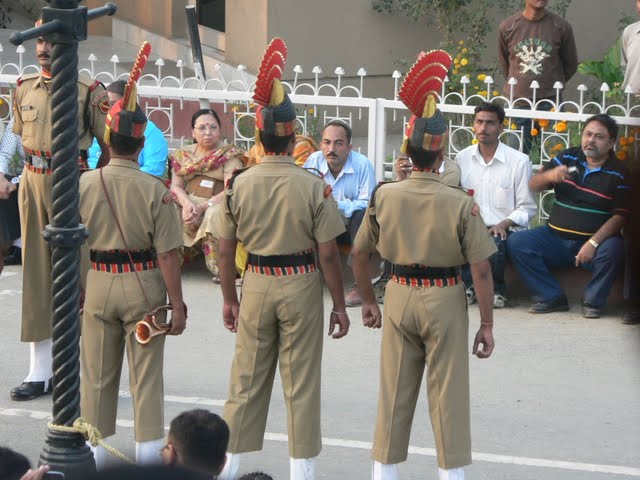
Indian Border Soldiers
Flag Races
We were not allowed to take bags, so I left my rucksack on the bus, taking just my camera and handbag.  It was a long walk from the car park to the border, but we got there eventually.  Just before the border, we had to go through a security check.  There were long queues, but we jumped the queue again.  Luckily, my handbag was small enough to pass.
Stands next to Ours
Stand Facing the Border
Having got through, we passed a very tall soldier.  His exceptional height was enhanced by high soles to his boots and a red fan made from the band which went round his hat.  He directed us to the stand for foreigners, which was nearest to the border.  The stand was filling from the back and another soldier made sure that no one left any gaps as they sat down.  Occasionally Indians tried to cross into the stand, but the soldier blew his whistle and told them to keep out.
Flags at End of Races
Dancing
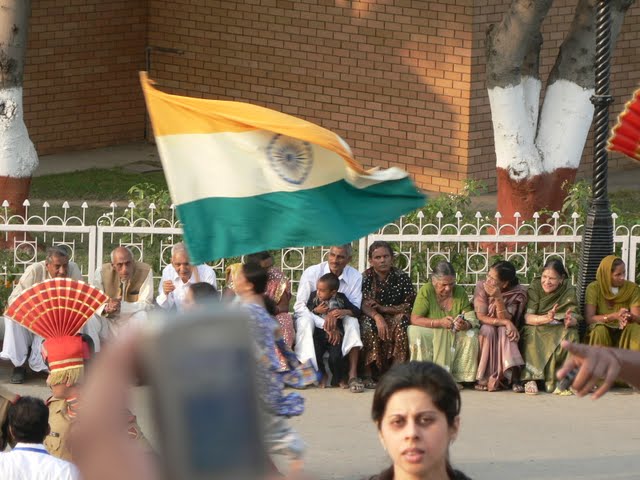
Once we were settled, we were able to watch the proceedings.  People were having races, two by two, carrying the Indian flag.  People walked down and queued for the chance to join in.  Some of the soldiers were responsible for giving the flags to the runners.  As more people came down, they began to race with four flags at a time.  Meanwhile, the stands continued to fill up and we could see the stand diagonally opposite on the Pakistani side of the border slowly beginning to fill up with women.  Some privileged people sat at the ground level, opposite us, where they could get a really good view.
Fast Walk to the Border
Soldiers and Privileged Audience
Eventually the races stopped and some flag bearers ran up the steps beside our stand and stopped.  Next they played some music and many young people went down and started dancing.  I recognised some of the steps as being typical Bollywood moves.  More and more people joined the dancing and it was a real party atmosphere.
Ladies in Pakistan
Unfortunately, when the music stopped any the border closing ceremony began, the dancers had to dash to the stands and the careful seating plan was destroyed in an instant.  Worse, some people stood up, which meant that the views were restricted.  A chant was started up, with the response from the crowd being “Hindustan”.
Guards on Both Sides
A soldier shouted, kicked his leg up high and then did a fast walk to the border gate.  Others joined him and there was a lot of strutting and posturing, shouting and gesturing and it was replicated on the Pakistani side.  Their soldiers were not as flamboyant as the Indian ones and wore black with belts and hats trimmed with red.  Their hats were crowned by narrower plumes rising from a single point at the back of their hats.  There seemed to be lots of empty seats over there.
Then there was exaggerated swishing of flag ropes and more posturing.  The soldiers shouted at each other across the border with their arms held out wide, as if to say “You Shall Not Pass”.
Sorting out Flag Ropes
People now started to shuffle forwards and, after being kicked a few times, I stood up too.  The view was still intermittent.
The Pakistanis played their national anthem.  Then the Indian anthem was played, but it was hard to hear with all the noise going on.  The flags were lowered, folded and marched back to the gate house and the gates separating the two countries were shut.  Although, I was not able to see much of this, the atmosphere was amazing.
You Shall Not Pass!!
Then it was all over and we had to make our way out and walk back to the car park.  We waited for the bus in front of a café and some people bought a drink.  Then Rafeeq led us to the car park behind, but we could not find the bus there.  Eventually we tracked it down – exactly where we had left it!
Back at the hotel, we had time to brush up and do a bit of packing before going down for dinner.  I left Jude and went to the bar, where I sat with Ken and Sue.  I had a screwdriver, but it had salt on the rim so was not particularly nice.   So I reverted back to lime and soda for my next drink.  At least I got enough change to be able to finally repay Bob the money I had borrowed from him.
I had another vegetable jalfrezi, but this time with rice instead of naan bread.  It was a huge portion of rice, so Sue had some.  It was a good meal, but not as nice as at lunch.  I got everyone’s email addresses and promised to pass them round as soon as I got home.
At the end of the meal, Ken and Sue left to visit the Golden Temple in the moonlight.  Next morning, they said that it was very pretty and lit up all over.  The others went to the bar.  I did not feel too well and went straight to bed.

Day 16 – Home again
Not that exciting a day, so I have summarised the highlights (and lowlights) as:
·        seeing a rat in the dining room at breakfast :-(
·        first plane late on take off :-(
·        no time to buy duty free at Delhi airport :-(
·        plane taking off late from Delhi :-(
·        my rucksack being almost last one off conveyor belt – big panic!
·        not being able to say goodbye to anyone except Bob :-(
·        making it to Kings Cross in time for my train :-)

The end
Coming soon(ish):
North Africa: A tale of wonderful ruins and nasty bugs

14 India


Day 15 a.m. – Amritsar
I got up at 0700, which was late for me.  It was early enough to make breakfast at 0800.  That was very disappointing and I had to make do with tomato sandwiches.
A Traffic Jam
Typical Tractor
We set off for the Golden Temple at 1000 in cycle rickshaws.  I was sitting with Chris again.  Soon we found ourselves in the best traffic jam of the holiday.  There were no lorries, but the road was packed with horse and carts, tractors with trailers, bikes, motorbikes and cars.  The jam was so dense that the motorbikes and bicycles created extra lanes by going onto the pavement, so the pedestrians were forced to weave their way between all the traffic in the road, adding to the confusion.
Jude out of Traffic Jam
At long last we turned left and broke free.  We were told to get out of the rickshaws so that the driver could cycle it up the steep slope of a bridge over a railway line.  Once he reached the top of the bridge, we climbed back in and had a mad drive through the shopping area, followed by another walk when the road sloped upward again.
The Golden Temple
Eventually we reached the Golden Temple.  People were selling head coverings, but I had brought the scarf which Rafeeq had given us for Shimla.  Then we had to take our shoes and socks off, wash our hands and then walk through a trough to wash our feet.  Properly cleansed and attired, we were now able to walk through the gate into the temple complex.  There were lots and lots of people there.
Girls Wanting my Photo
Why?  Guards look Good Though
We could see the Golden Temple itself in the centre of the “tank” (lake) in the middle of the complex.  It seemed a lot smaller than I had imagined.  I took a lot of photos though and nearly lost the group because I was waylaid by five girls, wearing all-white outfits, who wanted photos with me in them.  I must have looked a sight with my scarf, patterned skirt and ethnic bangles round my wrist.
Mike with Fully Fledged Sikh
Our guide took us round the temple and explained some of the history and what it meant to be a Sikh.  There was a holiday atmosphere because we were coming up to an important date in the Sikh calendar in two days time – the anniversary of the birth of Guru Nanak Sahib, the first guru.
Long Queues on the Causeway
The queues for the temple were very long, but we were led through by the exit.  Apparently it is not queue jumping for Europeans, but intended to protect us from pick-pockets.  Chris and I fought our way against the crush.  The people who were leaving all seemed to be eating something – and dropping it too.  This was special food given to the worshippers as they left the temple.
There was some confusion as to where we should go.  One lady said that we had to go the way we had come in and did not understand that we had come in through the exit.  An official pointed out a route up some stairs and, to our big relief, we spotted Jill and Lucy.  Now we could relax and look around us.
Girls in Holiday Mood
The decoration on the inside of the temple was very intricate with red and gold patterns.  From our vantage point, we could look down at the main part of the temple, which had an awning and a lot of people listening to someone speaking.
Boys Posing in Holiday Mood
We climbed up another staircase and reached the roof.  A man was reading aloud from a very large book.  People were sitting all around.  Some were reading; some were meditating; and some were just watching and listening.  I walked round and reached another staircase.  I made my way down and out of the temple.
Procession Outside Temple
Once we were all together, we continued our tour of the temple complex.  As we passed one of the gates, we saw a procession going past and went outside to watch for a while.
Washing Up
We had to wash our feet again to get back inside and then headed for the kitchen – the biggest in the world.  We went in through the washing up area.  It was all being done by hand by an army of people, all volunteers.  Used food trays were thrown into tubs of water, which meant that the floor was very wet in places.  The trays made their way through the “production line” until the clean and dry trays were stacked at the end.
Clean Trays
Huge Curry Pot
We moved on to the kitchens proper where huge cauldrons were cooking the curries.  My favourite part was where they made the chapatis.  There was a machine for this.  A man kneaded the dough and placed it on the machine, where it was flattened and then cut into circles.  A second man separated out the unused dough around the circles and the machine took it back round to be reused.  The chapatis moved on to the hot section of the machine which moved at just the right speed to ensure that they were nicely cooked when they fell off the conveyor belt.  People then scooped them up and put them into baskets.  It would have been nice to try one, but we were just observers.
Chapati Production Line
Kneading the Dough
The Cut Chapatis
Collecting the Cooked Chapatis


After allowing us time to explore the site, our guide led us out of the temple complex  and, after a short walk, through a narrow passageway to the Jallianwala Bagh.  This was an enclosed park which was the scene of a terrible massacre in 1919, when Brigadier-General Reginald Dyer ordered his men to fire on a gathering, killing lots of unarmed men, women and children who were unable to escape.
Eternal Flame
Museum
The site included the eternal flame to commemorate the fallen and a museum.  I stood near Mike when we were in the museum and he sounded appalled at what the British had done.  I think we all were.  Richard Attenborough did not hold back on the incident when he included it in his film “Gandhi” and it is a dark moment in the film.  The park included a wall which contained 28 bullet holes and the “Martyr’s Well”, which many people had jumped into to avoid the bullets, but then got crushed.  More people were crushed in the rush to the few, narrow exits.
Wall with Bullet Holes Marked
Memorial and Boys
Despite this being the site of an atrocity committed on the order of a British General, there were no ill feelings towards us.  In fact, it was here that I experienced more friendliness than anywhere else.  As I walked round, a couple approached me and I was asked if I would be in a photo with the wife.  She was very shy and had a mask over her mouth, but she removed it for the photos.  Perhaps she had a cold or something.  I was very happy to pose with her and then took a photo of the couple with their camera.  I passed them again later and we greeted each other as friends.  I wish I had taken their photo with my camera too.
There were lots of young people in the park and we kept on being approached by groups of boys and teenagers who wanted us to take their photos.  I asked if they had email addresses, so that I could send them on, but they did not seem to understand.  My photos from earlier holidays have been criticised for not having many people in them, but I made up for it here with lots of smiling faces.
Procession through Amritsar
Colourful Crowd Watching Procession
Eventually it was time to leave and we headed back through the narrow passage.  By this time, the procession was in full swing and we walked alongside it while we made our way to the rickshaws.  People were playing musical instruments as they marched and a brightly coloured crowd had gathered to watch.
Once we were all aboard our cycle rickshaws, Rafeeq took us to a very nice restaurant for lunch.  I had vegetable jalfrezi and naan and it was possibly the best meal of the whole trip.