Tunisia - 30 September 2010 (3)

Troglodyte Houses 

We passed through a village.  I knew it was there because I could see its name on a sign, but only one house was visible.  The rest were some of the famous troglodyte houses, built into the hills of the desert.  Many of these houses are now unoccupied and Lotfi said that only about 30 families still live in the old way.  Our next stop was to visit one of these families in another village.

Anna and Camel
Outside Oven
Not everything in the house was built underground.  The oven was outdoors beside the hill which had been excavated.  So was the outside loo.  While the others were listening to Lotfi’s explanation of how the oven worked, my attention was caught by a baby camel tethered in a hut nearby.  Anna, the lady who owned the house, held the camel for me to take photos.

View from Top of the Hill
We all climbed to the top of the hill from where we could look down into the inner courtyard of the house.  Anna’s widowed sister, who always seemed to be smiling, waved up at us.  She was making the tea.

Anna's Widowed Sister
We climbed back down and entered the building, making our way to the courtyard through a tunnel.  There was a cat just inside the courtyard and it soon made friends with Sue.  Refreshments were served: typical Berber bread and mint tea.  Vic must have liked the tea because he went round drinking the spare glasses.  We were allowed to look around, so explored all the rooms off the courtyard.  There was a kitchen with an electric stove, a store room and a few bedrooms.  There were not many furnishings, but enough to live in reasonable comfort.  Anna’s husband put in a brief appearance, but soon went out again.

Bedroom
Lotfi asked Anna about her family.  She had had ten children, but only five were still alive.  Their ages ranged from thirteen to thirty.  The thirty year old daughter was now married and lived away.  The others were all at school.

Anna and Anne Grinding the Barley
The main crop in the desert was barley.  Anna demonstrated how she used her mill to grind the seeds.  Heuly tried, but found it quite difficult.  Anne and Sue used their left hands and found it much easier, but it still would have been hard work to have to grind a whole batch of barley.  Anna also showed us the rugs she had made.  They were for sale, but none of us were tempted.  When we were at the top of the hill, we had noticed a store room halfway up the wall where things were kept well clear of rodents.  A rope hung down and Lotfi demonstrated how they climbed up to use the room.  The climb was also quite hard work.  As I looked up at the walls, I saw a couple of bird nests in some high niches.

Lotfi Climbing to the Storeroom
Terraces in the Desert
After saying goodbye, we got back on the bus and headed for a lookout point.  Although everything looked very dry and sandy, we could see the terracing which held the rainwater for as long as possible to give the crops time to grow.  There was no sign of the rain we had experienced in Kairouan.  We could see the sea in the distance.


The Desert

Tunisia - 30 September 2010 (2)

Into the Desert

Sfax War Cemetery
The first stop on our journey was the Sfax war cemetery.  Most of the graves here were for people killed at the end of the World War II fighting in North Africa in 1943.  There were graves for people of many Commonwealth countries: New Zealand, Australia, Canada and India as well as Britain.  Many of the British dead came from Scottish regiments, especially the Black Watch, Gordon Highlanders and Argyll Highlanders.  The Indians were buried behind the main cemetery in an area reserved for Moslems, Hindus and Sikhs.  One of them had the Victoria Cross.  Many were just 18 or 19 years old.  Although many years have passed since they were killed, I found it all very sad.

Sand Roses
We got back on the bus and drove through the industrial outskirts of Sfax and then along the coast.  We stopped for lunch at a very expensive service station, which did not have much in the way of vegetarian food, so I ate the bread I had bought in the medina.  Outside, they had piles of brown crystals, which had apparently grown in the sand when the rain dripped through.  Some people took one as a souvenir, but I thought they would get damaged in my luggage.

As we headed south, the number of Libyan lorries increased.  They could be clearly identified by their white number plates – Tunisian number plates are black.  We passed lots of restaurants serving lamb.  The dead lambs were hanging up outside each one to prove that they were fresh and male.  Then we started to notice piles of plastic containers alongside the road.  These contained very cheap petrol, brought over from Libya by the lorry drivers for sale on the black market.  Lotfi said that one litre of petrol in Libya was cheaper than one litre of water in Tunisia.  I worried about the fire hazard.  The containers looked very fragile and the day was growing very hot.

We were now in the desert, where dates were very cheap, especially as they had just come into season.  We stopped to buy some.  After Kim’s generosity with the coffee the other day, I felt obliged to reciprocate and bought a kilo for everyone to share.  Unfortunately, the sharing did not work out as well as I had hoped and we ended up having to throw some away.

Piles of Henna
New Style Minar

We stopped in Gabes for a coffee break and the bus dropped us near to a market.  This was mixed with stalls containing beautifully sculpted piles of spices and henna for the locals and other stalls selling t-shirts and jewellery for the tourists.  I decided to avoid some washing and bought two t-shirts, decorated with camels, to tide me through to the end of the tour.  The guy who sold them to me turned out to be quite annoying.  Once he had made his sale, he kept trying to touch my hair.  I guess Tunisian men might have a hair fetish because it is often hidden.  After making my purchases, I joined the others outside the café.  The mosque was opposite and had a very modern looking minaret.

We continued south, still following the coast and crossed the railway line several times.  We passed more than one train that afternoon.

Tunisia - 30 September 2010 (1)

 Sfax

Western Gate to Medina
After a reasonable breakfast, Vic, Caroline and I met up to walk to the medina.  The policeman directing traffic on the roundabout at the end of the road kindly stopped the traffic for us.

Southern Gate to Medina
There were arcades alongside the shops on the next road, which meant we could walk in the shade.  The medina was surprisingly close and it did not take long to get there.  We went in through the western gate.  It was still very quiet, so we walked straight out through the southern gate to see the French colonial buildings.  The town hall was in front of us, looking very Arabic with the palm trees in front and with its dome and clock tower, resembling a minaret.

Sfax Town Hall
French Colonial Buildings
We walked on down to the port and could see the cranes used to unload the ships.  There was a railway line and a main road between us and the sea, so we took a few small risks: we walked across the railway line and managed to find a gap in the traffic to cross the road.  It was not really that exciting when we reached the sea, but we could see lots of small fish in the water below.

Train on the Track
Crossing the Railway Line
We walked along the road for a while until we came to a crossing.  A train came along, showing that the railway line was far from being disused.  We had to avoid puddles as we came to the level crossing and some of the cars would have splashed us if we had not stood well back and waited for a large gap in the cars before negotiating the largest puddles.  Then we found ourselves in a large open area around what must have been an old harbour.  There was a single café, but not much else yet.  If it had been a similar city elsewhere, this would have been a very trendy area, with cafés, bars, shops and a few expensive apartments.  Perhaps it will be developed one day.

Shopping in the Medina
When we got back into the medina, it was much busier.  Near to the entrance I bought a round loaf.  Its texture was a bit like naan bread and it was so hot, I could barely hold it.  Then I went in search of a torch to use in the underground cave hotel we were staying in.  I had brought a maglite torch with me, but the batteries had leaked and done irreparable damage, so it had ended up in the bin.  There were no torches on display on any of the stalls and I could not remember the French for “torch”, so it took a while to make people understand what I wanted.  One of the stallholders took me under his wing and we went from stall to stall, hunting for torches.  It took quite a while before we struck lucky and I got a very powerful torch for just D2.500 and its battery for D1.500.  I have never seen a battery like it.  It is large and square with two metal flaps at the top.  I showed it to a retired electrician friend of mine the other day and he said it brought back memories.

Local Clothes on Blond, Western Models
Wooden Utensils for Sale
Vic wanted to stop for a coffee, so we had one in a small café, where we could sit on some very high stalls and watch the shoppers walk by.  I kept my camera out as we walked through the medina.  Canaries in cages sang to us as we walked.  There were lots of clothes stalls, but they mostly sold traditional long clothes for women.  They were in bright colours and were displayed on models – many of them blond, though I never saw a blond Tunisian.  There were also many shoe shops.  Lotfi had said that Sfax was the shoe capital of the world.  Luckily, my sandals were proving to be extremely comfortable, so I felt no need to buy more shoes.  At the far end of the medina, we looked out to the open market below.  Then we headed to the gate nearest to our hotel.

Veggies and Water
This northern section of the market was busier.  It contained many fruit and vegetable stalls and young men were struggling through the narrow alleys dragging heavily laden carts.  Other stalls sold nothing but wooden kitchen utensils.  We should probably have taken the opportunity to buy more items to eat during our journey, but at the time we did not realise that we would appreciate some decent food.

It was only 10.15 when we got back to the hotel, but it was a really hot walk back.  Once again, the friendly policeman helped us to negotiate the roundabout near the hotel.  At the hotel, I had a quick cold shower, finished packing and then it was time to leave the room.

Tunisia - 29 September 2010 (4)

Sfax

After the museum, we set off for Sfax, the second city of Tunisia and the commercial centre.  We hit town during the afternoon rush hour, so it was a slow drive to our hotel.  When we got there, I braved the traffic on the main road to get to a chemist on the other side.  It took a while, but I survived unscathed, made my purchase and then ventured back again, arriving before the cases were fully unloaded from the bus.

After just half an hour in the hotel, Lotfi took seven of us into the medina in the bus.  We went in through the south entrance and walked past lots of stalls.  There were some odd combinations.  For example, more than one stall displayed bottles of nail varnish between the spices.  We took a brief look at the mosque and then toured the fish market.  This was very smelly and, as it was the end of the day, had nearly sold out.

We then headed back towards the south wall to try a café which had been recommended.   On the way, we stopped for Caroline and Heuly to buy some top selling Arab music.   The café was highly over-rated.  It was in the wall of the medina and there was nowhere to sit outside and people watch like we wanted to do.  The main entertainment was the TV, which was on high volume and showed a football match.  Definitely not my idea of fun and it destroyed any atmosphere in the café.  There were not many other people in the café, but there were a few young men who were all smoking sheesha pipes.  I had an Arabic coffee and that was nice.

Just after we walked out, we spotted a restaurant and decided to have dinner there.  We said goodbye to Lotfi who was off to the supermarket and I took on the role of interpreter.  We were a bit worried about the cleanliness of the place, but we were reassured by a sink just in front of the kitchen area, which meant that people could wash their hands.  The menu was dominated by meat dishes including lamb cooked in several different ways.  Caroline and I had Tunisian salad and chips.  Her chips were hot, but mine came immediately and were cold.  The others ate lamb or chicken and said that their food was good.  All the meals were less than D9.000, so at least it was cheap.

After the meal, we headed out of the medina and, after a bit of a wait, were able to find taxis to take us back to the hotel.  Lotfi had said it would cost D5.000, but the fare was much lower than that.

Tunisia - 29 September 2010 (3)

Museum of El Djem

Animals fighting in the Amphitheatre
Dionysus on a Tiger
Our next stop was the museum.  Lotfi said that it was 400m from the amphitheatre but the bus took a scenic route.  We drove down a road where young couples came from all over Tunisia to buy furniture for their new homes.  Everything was imported from China.
Owl and Unfortunate Birds
Water Nymph, Seahorse and Dolphins


Garden of Restored Roman Villa

Goddess Africa
The museum consisted of a reconstruction of a Roman villa, with mosaics displayed to show them in context, a preserved villa and ruins of buildings with just outline walls and a few mosaics left in situ.  As with many of the archaeological sites, the mosaics left outside had no protection against weather or people walking on them.  The mosaics in the reconstructed villa were very delicate, made with tiny tesserae, like the ones in the Bardo Museum.  Many of them showed Dionysus with his drunken father and the wild animals he had ridden.  The four seasons were also prominent.  Some of the mosaics showed gory scenes of the entertainments in the amphitheatre: most of animals fighting each other, but one of animals killing Germanic prisoners of war.  The restored villa contained the only surviving mosaics of the goddess Africa in two adjacent rooms.  Though different, the designs of both her headdresses were based on the elephant with its ears, trunk and tusks.
Goddess Africa

Tunisia - 29 September 2010 (2)

Amphitheatre of El Djem

Amphitheatre from Restaurant
Amphitheatre of El Djem
After a fruitless search for a cup of coffee, we got back on the bus and headed on to El Djem.  This was definitely my favourite place in Tunisia as the amphitheatre there was most impressive.  The amphitheatre was the third largest after the Colosseum and Capua and has three storeys.  It is still the highest building in town.


Amphitheatre of El Djem
Ruth led us to the entrance to the amphitheatre and then left us to get some lunch.  After wandering round for a while, we decided to go to a restaurant immediately opposite the entrance.  It was probably not the cheapest restaurant, but what a view!  The waiter spoke quite good English and kept mentioning Leeds.  I suspect he had enjoyed a fling with someone from there as Leeds is not quite on the tourist trail – though perhaps it should be with the Armouries, Armley Mills, Kirkstall Abbey and Butterfly World.  I had omelette and chips with Tunisian salad (mostly white cabbage and tomatoes).  The chips were really hot – a rare pleasure – but the best treat was a glass of freshly squeezed orange juice.  During the second half of my first stay in Egypt, I had lived on freshly squeezed orange juice and I was expecting to enjoy it quite often on this trip.  To my great disappointment, it was offered just twice on the whole tour.

Corridors of Amphitheatre
Me at top of restored seating
After lunch, Lotfi led us inside the amphitheatre.  It was so stunning, I involuntarily said “Wow!” several times.  I would have liked to have been able to stay there for hours, soaking up the atmosphere and exploring every corner.  Unfortunately, Lotfi spent a long time explaining what happened there and, by the time he had finished, we were issued with the dreaded “back on the bus in 20 minutes”.  During his talk, Lotfi took us underground to see the cells where they kept the gladiators and the wild animals before they went on.  While we were down there, we had to walk round the men who were carrying out restoration work and avoid the puddles from the day before.  At one point, we had to walk a plank to keep our feet dry.  We went right down to the far end and saw the ramp where they unloaded the wild animals.

Amphitheatre of El Djem
During our free time, we dashed through the corridors, which allowed access to the seating and climbed to the third storey.  Then we crossed to the new, restored seating on the opposite side to get good views of the old section of the building.  I did not rush to get back to the bus on time as I knew it would not go without me.  In the end, quite a few of us walked back together because Anne, Robin and Sue had tried to walk round the other way, but had come to a dead end and had to retrace their steps.  Just as we got back, I saw a camel resting his head on the pavement.  Unfortunately, he lifted it as we approached.
Amphitheatre of El Djem
View of El Djem from Amphitheatre


Tunisia - 29 September 2010 (1)

Kairouan


Aglabid Basin
Tiles in Zaouia of Sidi Sahab
The call to prayer woke me well before 05.00 because I fell asleep afterwards and woke up again at 04.55.  I got up at 05.30 and had showered and packed by the time Caroline got up.  Breakfast was at 07.00 and tainted by a very surly waiter who was not happy that Vic, Caroline and I had sat at a long table which had been earmarked for another group.


Decorations in Zaouia of Sidi Sahab
We left the hotel at 08.00 and headed for the Aghlabid basins.  The entrance building had a flat roof and we were able to look down on the pools from there.  There used to be 14 pools, which provided the water supply for the city.  Small pools acted as filters and, when full, fed the larger pools.  There were cisterns to store excess water.  As I looked down, I could see sparrows bathing in the puddles left from yesterday’s rain, although there must have got pretty wet while it was raining.  As we left the pools, we went to look at a camel.  Lotfi started to panic as he thought we were going to get on the wrong bus!

Courtyard of Zaouia of Sidi Sahab
Minaret of Great Mosque
Next stop was the Zaouia of Sidi Sahab.  As this included a mosque, we put our scarves on, although another party was wandering about with heads uncovered.  The building was partly in the Andalusian style and had decorative tiles and wonderful ornate ceilings and walls.  Lotfi explained how the courtyard was designed to collect any rainwater for recycling.  In such a normally dry area, it became a religious requirement that not a drop of water should be wasted.  The building also contained a school and a refuge for pilgrims.  The only part we were not allowed to enter was the shrine to Sidi Sahab.

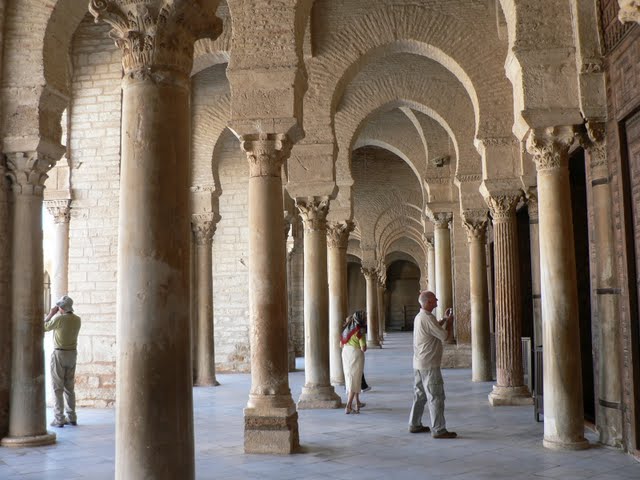
Ancient Columns in Great Mosque
Prayer Hall in Great Mosque
Our final stop in Kairouan was the Great Mosque.  This is the 4th most important mosque, after Mecca, Medina and Jerusalem.  Lotfi introduced it as being the largest collection of ancient Roman columns.  These were recycled in the portico outside the prayer hall and within the prayer hall itself, where their bases were covered in rugs for protection, though whether for the columns or the faithful, I do not know.  We were not allowed inside the prayer hall, but were able to look in and admire the chandeliers and the ancient columns and see the minbar, from where sermons are delivered.

Sundial in Great Mosque
Recycled Stones in Great Mosque
Once again, the courtyard was designed so that any water would be collected and stored in underground cisterns.  At the centre of the courtyard was an ornate filter.  The ornamentations were not decorative, but designed to remove any dirt.  Lotfi said that there was another filter below to complete the task.  The courtyard contained the capitals of some ancient columns, which had been hollowed out and given lids.  These provided access to the stored water so that the faithful could carry out the required ablutions before going to pray.  We looked inside one of them, which bore large indentations, showing where the ropes used to raise the water had worn away the stone over the centuries.  There was also a sundial in the courtyard, which could be seen by climbing a set of steps.

Central Drain in Courtyard of Great Mosque
After exploring the main courtyard, we moved through to another, where there was a school and dormitories for the students.

We left the mosque and looked for a coffee shop.  We walked up and down the road to the side of the entrance several times, past people trying to sell us souvenirs or shoes.  A young man in a wheelchair was whispering “postcards”, but he was selling them in strips so I was not interested.