Tunisia - 29 September 2010 (2)

Amphitheatre of El Djem

Amphitheatre from Restaurant
Amphitheatre of El Djem
After a fruitless search for a cup of coffee, we got back on the bus and headed on to El Djem.  This was definitely my favourite place in Tunisia as the amphitheatre there was most impressive.  The amphitheatre was the third largest after the Colosseum and Capua and has three storeys.  It is still the highest building in town.


Amphitheatre of El Djem
Ruth led us to the entrance to the amphitheatre and then left us to get some lunch.  After wandering round for a while, we decided to go to a restaurant immediately opposite the entrance.  It was probably not the cheapest restaurant, but what a view!  The waiter spoke quite good English and kept mentioning Leeds.  I suspect he had enjoyed a fling with someone from there as Leeds is not quite on the tourist trail – though perhaps it should be with the Armouries, Armley Mills, Kirkstall Abbey and Butterfly World.  I had omelette and chips with Tunisian salad (mostly white cabbage and tomatoes).  The chips were really hot – a rare pleasure – but the best treat was a glass of freshly squeezed orange juice.  During the second half of my first stay in Egypt, I had lived on freshly squeezed orange juice and I was expecting to enjoy it quite often on this trip.  To my great disappointment, it was offered just twice on the whole tour.

Corridors of Amphitheatre
Me at top of restored seating
After lunch, Lotfi led us inside the amphitheatre.  It was so stunning, I involuntarily said “Wow!” several times.  I would have liked to have been able to stay there for hours, soaking up the atmosphere and exploring every corner.  Unfortunately, Lotfi spent a long time explaining what happened there and, by the time he had finished, we were issued with the dreaded “back on the bus in 20 minutes”.  During his talk, Lotfi took us underground to see the cells where they kept the gladiators and the wild animals before they went on.  While we were down there, we had to walk round the men who were carrying out restoration work and avoid the puddles from the day before.  At one point, we had to walk a plank to keep our feet dry.  We went right down to the far end and saw the ramp where they unloaded the wild animals.

Amphitheatre of El Djem
During our free time, we dashed through the corridors, which allowed access to the seating and climbed to the third storey.  Then we crossed to the new, restored seating on the opposite side to get good views of the old section of the building.  I did not rush to get back to the bus on time as I knew it would not go without me.  In the end, quite a few of us walked back together because Anne, Robin and Sue had tried to walk round the other way, but had come to a dead end and had to retrace their steps.  Just as we got back, I saw a camel resting his head on the pavement.  Unfortunately, he lifted it as we approached.
Amphitheatre of El Djem
View of El Djem from Amphitheatre


Tunisia - 29 September 2010 (1)

Kairouan


Aglabid Basin
Tiles in Zaouia of Sidi Sahab
The call to prayer woke me well before 05.00 because I fell asleep afterwards and woke up again at 04.55.  I got up at 05.30 and had showered and packed by the time Caroline got up.  Breakfast was at 07.00 and tainted by a very surly waiter who was not happy that Vic, Caroline and I had sat at a long table which had been earmarked for another group.


Decorations in Zaouia of Sidi Sahab
We left the hotel at 08.00 and headed for the Aghlabid basins.  The entrance building had a flat roof and we were able to look down on the pools from there.  There used to be 14 pools, which provided the water supply for the city.  Small pools acted as filters and, when full, fed the larger pools.  There were cisterns to store excess water.  As I looked down, I could see sparrows bathing in the puddles left from yesterday’s rain, although there must have got pretty wet while it was raining.  As we left the pools, we went to look at a camel.  Lotfi started to panic as he thought we were going to get on the wrong bus!

Courtyard of Zaouia of Sidi Sahab
Minaret of Great Mosque
Next stop was the Zaouia of Sidi Sahab.  As this included a mosque, we put our scarves on, although another party was wandering about with heads uncovered.  The building was partly in the Andalusian style and had decorative tiles and wonderful ornate ceilings and walls.  Lotfi explained how the courtyard was designed to collect any rainwater for recycling.  In such a normally dry area, it became a religious requirement that not a drop of water should be wasted.  The building also contained a school and a refuge for pilgrims.  The only part we were not allowed to enter was the shrine to Sidi Sahab.

Ancient Columns in Great Mosque
Prayer Hall in Great Mosque
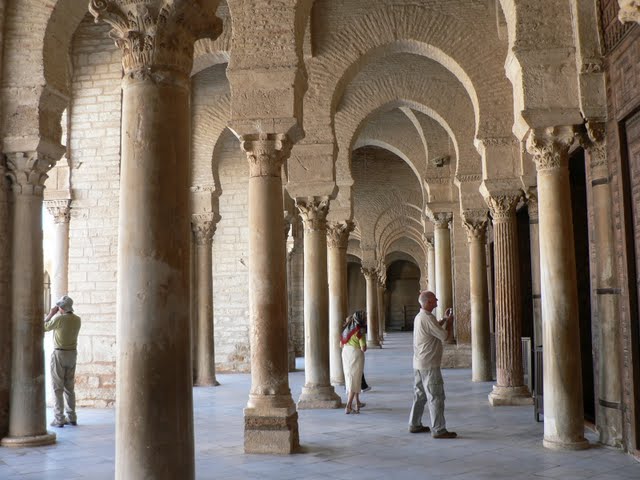
Our final stop in Kairouan was the Great Mosque.  This is the 4th most important mosque, after Mecca, Medina and Jerusalem.  Lotfi introduced it as being the largest collection of ancient Roman columns.  These were recycled in the portico outside the prayer hall and within the prayer hall itself, where their bases were covered in rugs for protection, though whether for the columns or the faithful, I do not know.  We were not allowed inside the prayer hall, but were able to look in and admire the chandeliers and the ancient columns and see the minbar, from where sermons are delivered.

Sundial in Great Mosque
Recycled Stones in Great Mosque
Once again, the courtyard was designed so that any water would be collected and stored in underground cisterns.  At the centre of the courtyard was an ornate filter.  The ornamentations were not decorative, but designed to remove any dirt.  Lotfi said that there was another filter below to complete the task.  The courtyard contained the capitals of some ancient columns, which had been hollowed out and given lids.  These provided access to the stored water so that the faithful could carry out the required ablutions before going to pray.  We looked inside one of them, which bore large indentations, showing where the ropes used to raise the water had worn away the stone over the centuries.  There was also a sundial in the courtyard, which could be seen by climbing a set of steps.

Central Drain in Courtyard of Great Mosque
After exploring the main courtyard, we moved through to another, where there was a school and dormitories for the students.

We left the mosque and looked for a coffee shop.  We walked up and down the road to the side of the entrance several times, past people trying to sell us souvenirs or shoes.  A young man in a wheelchair was whispering “postcards”, but he was selling them in strips so I was not interested.

Tunisia - 28 September 2010 (2)

Kairouan

After lunch, we headed for Kairouan and the Hotel Splendide.  The room had a lot of mirrors and was nice and light, but the shower did not look too clean.  We had half an hour to unpack and get ready for a tour of the medina.  Just before we left the room, the nearby mosque started the call to prayer.  We wouldn’t need our alarm clocks the next morning!

On heading into the medina, my intention was to look for skirts whilst the others had the promised trip into a carpet shop, but this did not happen.  Instead, Lotfi quickly led us from one side of the medina to the other along the Rue 7 Novembre, which is a very wide road for a medina.  We passed several leather shops and other shops selling very colourful spices.  There was some jewellery and quite a few clothes shops, but there was no time to look and, at first glance, they did not sell what I was looking for.

Bir Barouta
It started to rain and the stalls were put away, so we went into the Bir Barouta.  This is a sacred well.  The water is raised by a muzzled and blindfolded camel working a sakia.  Lotfi assured us that the camels worked two hour shifts and were then changed.  We stood round the edge of the room and watched him and I was able to stroke him when the “performance” was over.  The hair on the front of his neck was surprisingly soft.

It was still raining when we emerged, so we took shelter in an enclosed part of the medina.  But the rain showed no signs of stopping, so we set off in search of a “typical” old house which Lotfi wanted to show us.  The trouble was that he was unsure of the way.  At one point we went into a carpet shop to ask for directions.  The people inside started to get excited at the prospect of customers, but it was short lived as we left before they were able to get any carpets out.  One of the streets we walked down was completely flooded.  My feet, in my open sandals, felt horribly gritty.  Some of us were prepared and wore raincoats, but I just had my normal clothes for the day.  I contented myself with the thought that my hair would be lovely and soft after all the rain.

Eventually we did find the house and walked in looking like drowned rats.  Despite that, we were welcomed in and we were even allowed to sit on the seats, dripping copious amounts of rainwater.  The house had been used by the main family in Kairouan until just 10 years ago.  The grandson of the family was actually in the house during our visit.

The house had two reception rooms near the entrance: one for men and one for women.  The women’s room had tilted mirrors above the divans so they could admire themselves.  The kitchen was behind the women’s room.  There was just a small stove but a huge range of copper cooking pots of various shapes and sizes.  The bedrooms had a sleeping alcove at each end.  This was true even of the marital bedroom so that the wife could sleep alone when pregnant or when she had a new baby.  There were some steep stairs which led to a store room, but you had to go down backwards so I did not try.

The central courtyard was full of plants.  It was overlooked by an upstairs balcony decorated in wrought ironwork.  We went up and saw some more reception rooms with wonderful antique chairs.  The guest bedroom was here, also with two beds.

We went up some more stairs to the roof.  Unfortunately this was open to the rain, so we did not stay long.  On a sunny day, it would have been pleasant to sit up here and enjoy the views while drinking tea.  Instead we went back down to the men’s reception room for the most welcome tea and pastries.  I tried some of the makhroud, which are local delicacies made from dates.  They were surprisingly nice.  While we ate, the grandson took our photos.  I don't think that we made a good advert for the place in such a soggy state.  As we were leaving, I looked at the photos of the family when they lived in the house.  The grandson seemed so happy to have us as visitors, it was quite touching.

Lotfi had rung Hammadi, who was waiting in the bus by the nearest gate to the medina, so we did not have far to walk.  The rain was slowing, so we did not get really wet again.  The one way system meant that the bus had to take the long route round town, but we reached the hotel eventually.  Sparrows were coming in to roost in a nearby tree and there was lots of chirping despite the rain.

Caroline and I chilled out in the room, drinking cups of tea made with a travel kettle she had bought in Heathrow.  It did not seem to be working very well.    The call to prayer started again.  It was a real auditory experience, enhanced by the birdsong emanating from the roost.

At 19.20 we went for our daily briefing and then braved the rain to walk to a nearby restaurant.  Luckily it was not too far.  We all sat upstairs and opened the window.  We heard a wedding procession go past.  Not a good day for a wedding!  It was still raining when we finished dinner.  I went straight back to the hotel and bed, but Caroline and some of the others stayed out.

Tunisia - 28 September 2010 (1)


Sbeitla

Olive Press
I got up at 06.00 and was ready and almost packed by 07.00 for breakfast.  We recognised a few people in the dining room as we had passed them on our travels.  Although there were so few other tourists on the route, there were not that many hotels either, so it was inevitable that we should encounter the same people.  One of the good things about Tunisia (which was even more true in Libya), was that we almost had the ancient sites to ourselves when we visited them.  It was great to be able to listen to our guides without hearing the same tale in French or German and not to have lots of strangers cluttering the photos.

Mosaic in Baptismal Font
Palaestra in the Baths
As we drove out of town, Lotfi pointed out the statues of desert foxes with extremely long ears and wearing blue track suits.  These are Labib and his sons and were the creation of the Ministry of the Environment to encourage people, especially children, to keep Tunisia tidy and to save energy and water.  We passed these statues several times on our journey.

Underfloor Heating in Baths
Basilica
Our main site today was Sbeitla.  On the way there, we saw a monument of an apple, so we stopped to take photos.  We had a mini-revolt and went straight into a café, where Kim treated us all to coffee.  Next stop on the journey was at a roadside stall selling apples.  Lotfi said that they were a good price at D1.500/kg.  I never buy apples, so could not comment on the price, but I did buy a kilo here as I was starting to realise that vegetarian food would be hard to come by at times and I needed to eat more fruit.  I ate one of the apples at once and it was all right.

Theatre
Antonine Gate
Sbeitla was quite an impressive site.  It covered a large area which, unlike Dougga, was flat.  We walked round the whole site, starting at the olive press and then moved on to the baths.  There was a heavily restored theatre near the dry river valley, where we had a brief rest.  Sbeitla is famous for its six churches or basilicas.  As in Rome, some had originally been Roman temples, but had been converted when Christianity took hold.  Some of them had ornate, mosaic covered baptismal fonts and there were other mosaics on the floors.  The best area on the site was the forum, which boasted three impressive temples – to Jupiter, Juno and Minerva – on one side.  We approached the forum through the Antonine Gate and I spent quite a long time standing there, enjoying the cool breeze which was blowing through.

Temples in the Forum
Basin in Basilica of St Vitalis
We walked back to the entrance, which was an enclosed area on the other side of the road, with a few shops in an inner courtyard.  There was some confusion over lunch.  Lotfi wanted to take us to a pizzeria, but Ruth decided that we could buy food from the shops in the courtyard instead.  The food was very limited, so I had to settle for a muffin with some bad tasting chocolate cream inside and some water.  One of the complaints I did have about the tour was that there were quite a lot of “picnic” lunches with food gleaned from small supermarkets.  Without proper utensils, it wasn't that easy to find things to eat.
Font in Basilica of St Vitalis
Mosaic in Basilica

Tunisia - 27 September 2010 (2)

El Kef

Another of my feathered friends
As we headed back to El Kef, I fell asleep again.  We got out at the hotel instead of going into town to eat.  The hotel maids were eating in the area by the canaries and, very generously, offered us some of their lunch.  We thanked them but declined.

Heuly, Caroline and I went down to the pool.  The others were brave and went in, but only briefly.  The water was very cold when I tested it – just with my toes.  Anne joined us and then Ruth when she got back from town.  She managed to stay in long enough to swim two lengths.

Roman Baths
Later, we were taken back into El Kef.  I thought we were going to do some shopping, but Lotfi wanted to give us another guided tour.  Our first stop was to admire the cisterns of El Kef, but then we met someone who worked in a traditional house, now used as offices and for meetings and classes.  She invited us in to see the house, which was arranged around a central courtyard, with a garden in the middle in Andalusian style.  There were some very pretty, Tunisian made tiles on the walls.

Ruth had gone to find Werner, who said he wanted to revisit his hotel from a much earlier trip.  She failed to find him and met up with us in the old Roman baths. The site was surrounded by modern buildings, with apartment blocks forming part of the walls of the site.  There were lots of columns and votive stelae, but there were only a few rooms as these baths were smaller than others we had seen.

El Kef from the Kasbah
Then it was time to begin the climb to the Kasbah.  We went up and up and up.  Lotfi kept saying: “it’s not far now” as we came to the top of a flight of steps, but when we got there and went round the corner, there would be more steps and the climb would continue.  At long last we reached the Kasbah and discovered that there were two of them.
El Kef and City Wall

We went into the smaller one which was showing serious signs of neglect.  We climbed up to the walkway at the top of the walls and looked out over the town.  I did not take any photos as Lotfi said that there would be much better views from the other Kasbah, but I could see the inner courtyards of the blue and white houses down below and the mountains in the distance.

View across to Algeria
Then we went into the larger Kasbah, which was in much better condition and is used for concerts.  They were getting ready for a concert that week, which meant that we could not enter one of the rooms which stored all the equipment for the event.  The entrance to the Kasbah was over a moat.  Lotfi said that it had been full of crocodiles at one time.  As we climbed up to the roof, we were serenaded by hundreds of sparrows and some larger birds, which were coming to roost in a nearby tree.  A mobile phone tower was also a popular roosting site.

Kasbah from below
From the roof, Lotfi pointed out the flat mountain where Jugurtha held out against the Romans.  He said that some of the hills in that direction were in Algeria.  Algeria was just 40km away, which was why the Kasbah had remained an important military establishment for a long time.  Looking closer at the town, we could see the remains of the city wall.

After exploring the Kasbah, we headed for a café where we could enjoy our first Arabic coffee.  The café was in a dead end street, which had a tree growing at the end, providing some welcome shade.  Arabic coffee is exactly the same as Greek coffee or Turkish coffee.  We caused problems because we did not want the very sweet pre-made coffee, so we had to wait for our order.

Sparrows serenading us
I wanted to buy a skirt as I was not happy with the clothes I had with me.  Sue offered to show me where there were some market stalls, so we left the others and headed down the hill.

We walked past the synagogue and looked in through the door.  We avoided going in as it was getting late and there was an entrance fee.  Our descent took us through a courtyard, where some little boys wished us “Bon Jour”.  We chatted to them and their mothers as we walked by.  Unfortunately, the market was closing when we got there.  I did look at one clothes stall, but there was nothing suitable.  Keen to make a sale, the stallholders kept suggesting things, but they seemed to be the wrong material or too many frills and flounces or just too good for walking round dusty ruins.  I did try on one denim skirt, but it was too tight.

Sue wanted to go back to the hotel to fetch Kim and to see whether Werner had gone back there, so we started to look for a taxi.  A Brazilian girl, who had studied in England, offered her translation services, but we did not need them and soon found a taxi.  Sue found both Kim and Werner at the hotel so, after just a few minutes, we got into another taxi and headed to the Post Office, which we had been told was near to the restaurant where we were eating that night.

We looked for the restaurant, found one and asked if they had a reservation for 10-12 people.  We were in luck, so we waited and, just as we were about to order drinks, Ruth appeared.  This time we were not offered the set meal, but could place our own orders.  It was a nice meal: just D5.000 for salad and chips.

Tunisia - 27 September 2010 (1)

Bulla Regia


Cisterns and rear of Memmian Baths
Snails on a column
Breakfast was very good and I enjoyed what was probably the largest pain au chocolat I have ever eaten.  Ruth had bought some pomegranates and she opened one for us to try.  I am not a great fruit eater, but thought this was quite nice.  I was not sure whether to eat the seeds or not, having read the story of Persephone and the pomegranate, but the others ate them, so I did the same.

Memmion Baths
Memmion Baths
Our first stop today was Bulla Regia.  I read for some of the journey and then fell asleep.  I woke up as we went round a roundabout and the policeman on duty waved to Hammadi.  We either went round the same roundabout again or the policeman had a brother because, a few minutes later, we got another wave from someone very similar.

The car park for Bulla Regia was on the other side of the road from the site.  As we crossed over, three small boys walked past, wearing their school uniforms, and wished us “Bon Jour”.

Underground House
Peacock Mosaic
The first stop on the site was the cisterns – water was obviously a very important consideration and a feature of almost all the sites we visited.  An unknown building stood to the side.  I was more fascinated by the small white snails which covered some pillars in front of the building.  They were to be found throughout the site.  The large building behind the cisterns was the remains of the baths.  These covered 3,300m2 and, in some ways, were more impressive than the Antonine Baths in Carthage – though without the fantastic setting.

Mosaic of the Hunt
House of Amphitrite
Bulla Regia is important because it contains some underground houses.  As the day warmed up, I could definitely see the advantage of living below ground.  Several have been excavated and we saw people working on one called the “House of the Hunt”.  Some well preserved mosaics have been discovered underground and Caroline insisted that I went down into the second house to see the mosaic of Venus.
Lotfi Inside an Underground House
Theatre
There was not much left of the forum and market, but the theatre, though small, was still standing.  We entered through the back, like the audience would have done, exploring the corridors behind the seating.  We finally made it through to the seats and could see a mosaic of a bear on the stage area.

Bear Mosaic in Theatre
Donkey
As we left the site, we saw a lady with her donkey.  She was collecting water from a pipe and assured us that it was clean and OK to drink.  Werner shocked us all by using it to fill up his water bottle.

We were given half an hour to eat and look at souvenirs.  In the end, I was the only person to eat, but I enjoyed a very nice mushroom omelette.  The others just bought drinks and ate ice creams.
At last - a bird which is not a pigeon!